



Volume. Reputation. Workforce. Margin. It’s all connected.
After more than 20+ years working with 250+ health organizations, we’ve noticed something: everyone owns a piece of organizational growth. But almost no one is connecting the pieces.
Pick any health organization. You’ll find one team trying to drive patient volume or product sales. Another is building the organization’s long-term reputation. HR is focused on recruiting and engaging the workforce. Strategy is looking at markets, service lines and M&A. Innovation is building what’s next. Finance is protecting margin. Physician relations is working referrals.
And somewhere at the top, the CEO expects all of it to add up. Of course they do. It’s one organization. But it often doesn’t always work that way.
Healthcare organizations tend to manage growth the same way they manage the organization itself: by function. Different teams. Different budgets. Different data. Different KPIs. Different definitions of success. Meanwhile, growth is bouncing across all of them.
The market doesn’t care about your org chart
Cue Fleetwood Mac: never break the chain.
Very few organizational decisions stay neatly contained to the team that made them. Reputation affects preference. Preference affects demand. Demand affects capacity. Capacity affects experience. Experience affects loyalty. Physician relationships affect referrals. Workforce affects nearly all of it. And margin determines what you can invest in next. Whew… that’s a chain if we ever saw one.
Break one link, and the effects travel down the chain.
It sounds obvious, but when we look at how most healthcare organizations are structured, the problem is in plain sight. Growth doesn’t happen in departments. It happens in the connections between them.
Everyone can hit their goals, and the organization can still miss.
This is where it gets weird. Imagine a health system trying to grow orthopedic volume. Marketing does its job beautifully. The targeting works. The creative works. Demand jumps. There’s just one tiny problem: patients can’t get an appointment for six weeks.
Or a health system spends years building a truly excellent cardiovascular program. It recruits the physicians. Invests in new technology. Expands capacity. And then… consumers still think the competitor down the street is the heart hospital.
Or a pharmaceutical company launches an innovative new therapy. Commercial, Medical Affairs, market access and patient services are all moving. HCP awareness is high. Patients are interested. The science is strong. And then… coverage and access barriers keep the therapy from reaching the patients who need it.
Or maybe two organizations merge. The financial transaction closes. The operational integration begins. But the workforce was never bought in, and cultural differences prevent the merger from delivering value.
You get the idea. The maddening part is that none of these scenarios necessarily requires anyone to have done a bad job. Quite the opposite.
Every team can hit its goals. Marketing can deliver the leads. HR can hit the recruiting target. Operations can improve throughput. Communications can lift reputation. Finance can protect margin.
The parts can work while the whole underperforms. That’s a very expensive problem.
Mind the gap
At BPD Health, we get an interesting view into this because we tend to live between the boxes on the org chart. We start with a brand strategy, but need to first rally the workforce around the brand. We get asked to drive patient demand and quickly end up in conversations about access and capacity. We dig into physician referrals and suddenly we’re talking about reputation, relationships, operations and physician experience. We work on a product launch and connect research, positioning, HCP engagement, consumer behavior, communications and commercialization.
We’ve gotten pretty good at being the glue. And we’re happy to be the glue.
But at some point, we started asking a deeper question: Why does healthcare need so much glue?
Enter a big, hairy, audacious goal
That question led to an entirely new playbook for healthcare growth. What if we could engineer growth with intention?
That became our big, hairy, audacious goal earlier this year: build an enterprise growth system for healthcare.
One that connects intelligence, strategic advisory, activation and automation around the same growth objectives. Where an insight uncovered in one part of the organization makes another part smarter. Where we can see the downstream effects of a decision before they become someone else’s problem. And where success is measured by how the organization grows, not just whether an individual project delivered.
A system where the whole works together. Which brings us back to where we started.
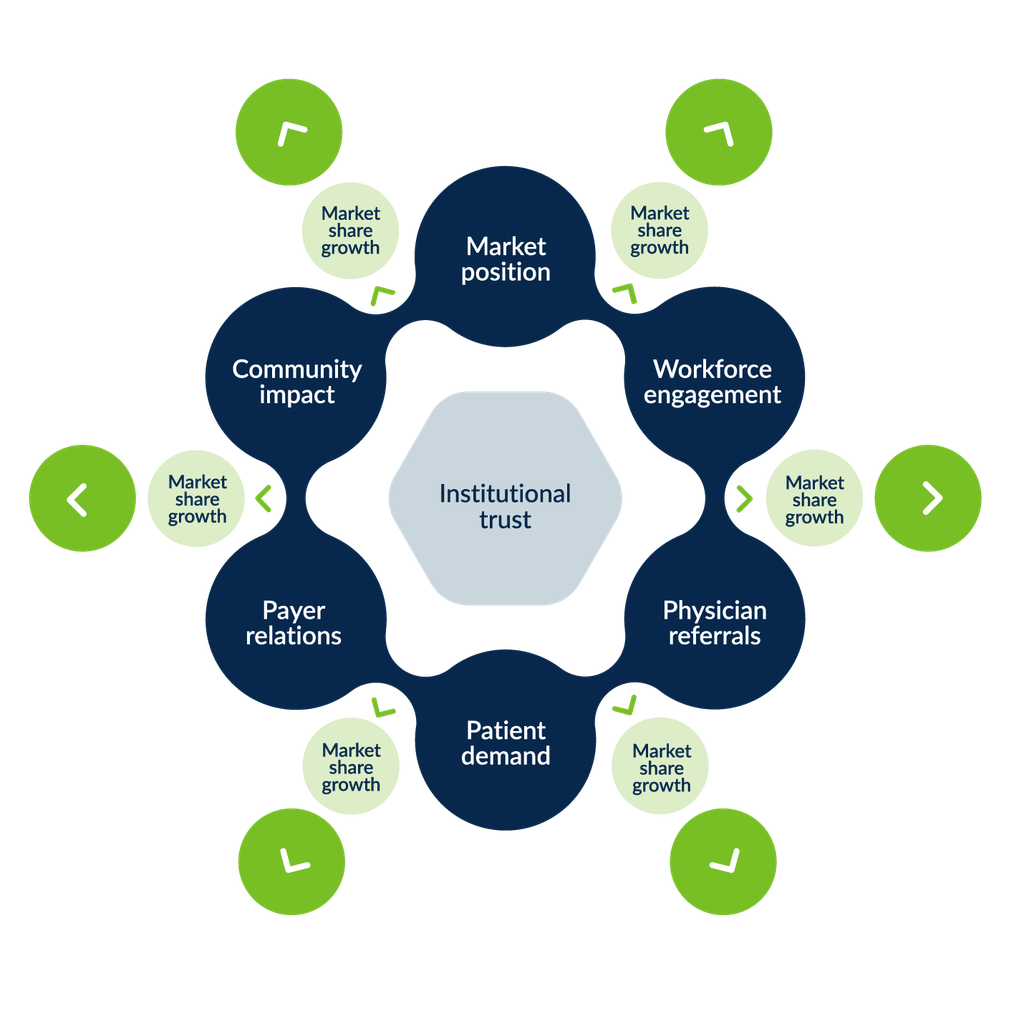
Growth is a living system
We call our enterprise growth system bpDNA. The name is intentional.
Genes operate in networks, influencing one another and responding to signals throughout the system. What happens in one place can change what happens somewhere else.
We believe growth works the same way. Every healthcare organization has its own DNA of growth: its market, reputation, consumers, physicians, workforce, operations, economics, data, capabilities and ambitions. There is no single lever to pull. No universal playbook. And no department that can do it alone.
The opportunity is to have the data and connected strategies to truly understand the system—and get more of it working together.
We’ll be sharing much more about bpDNA in the months ahead: what we’re building, what we’re learning and what happens when healthcare organizations start managing growth as the living system it is.
After 20+ years of helping healthcare organizations grow, we’ve never been more convinced of one thing: It’s good to grow.
Now let’s get the whole damn thing growing together.